In short
FOMO in trading means entering a move because you're afraid to miss it, not because your plan gives a signal. You mostly pay for it with late entries: with the same stop and target, your reward-to-risk collapses and the win rate you need climbs. It shows in your history (wider stops, planned ratio below 1, unusual symbols) and stops with limit orders set in advance.
Key takeaways
- FOMO in trading is an entry decision driven by the fear of missing a move, not by a signal from your plan.
- Its main cost is mechanical: entering late with the same stop and target crushes your reward-to-risk and raises the win rate you need.
- In the example of a Buy planned at 2R, entering 30 pips later moves the break-even win rate from 33% to 83%.
- Retail investors buy what grabs their attention: Barber and Odean (2008) measure nearly twice as many purchases as sales in stocks with unusually high volume.
- FOMO leaves traces in an MT4 or MT5 export: wider stop than usual, planned ratio below 1, inflated size, unusual symbol or time.
- The most effective rule is set before the session: a limit order at the planned level, and if price already left, the trade no longer exists.
A green candle stretches. Then another. On your feed, someone posts a screenshot of their gains. You had nothing planned on this pair, but you hit Buy, at market, almost at the top. Ten minutes later, price comes back exactly to where you should have entered, then lower. That’s FOMO in trading.
Most articles tell you to “stay disciplined”. This one does something else: it puts a number on what a late entry really costs, shows you how to find your FOMO trades in your MT4 or MT5 history, and gives you rules that work without willpower.
What is FOMO in trading?
FOMO in trading is taking a position because you’re afraid to miss a move, not because your plan gives a signal. The acronym stands for “fear of missing out”. Psychologist Andrew Przybylski and his co-authors defined it in 2013 as a pervasive apprehension that others might be having rewarding experiences from which you are absent. In trading, the “others” are the people already in the move.
It takes three forms:
- The late entry: you take a trade from your plan, but after price has already covered a good part of the way.
- The off-plan trade: you jump on a symbol or setup you never trade, because it’s “taking off”.
- The impulsive add: you add to a position because the move is speeding up, without that add being planned.
In all three cases, the decision comes before the analysis. You then look for reasons to justify a trade you already took.
Why you give in to FOMO
You give in to FOMO because your attention is limited and spectacular moves capture it. It’s not a character flaw: it’s a behavior measured at scale among retail investors.
Brad Barber and Terrance Odean showed it in 2008 in the Review of Financial Studies. Individual investors are net buyers of stocks that grab attention: stocks in the news, stocks with unusually high volume, stocks with an extreme move the day before. At the online broker they studied, clients made nearly twice as many purchases as sales in stocks whose daily volume was in the top 5%. Professionals, on the other hand, were the least influenced by attention.
Modern apps amplify the effect. In a study published in 2022 in the Journal of Finance, Barber, Huang, Odean and Schwarz analyzed purchases by users of Robinhood, an app that highlights lists such as “Top Movers” (the day’s biggest movers). The stocks most bought each day by these users then show an average abnormal return of −4.7% over 20 days. Buying what everyone is buying, at the moment everyone is buying it, has a measurable cost.
FOMO doesn’t make you miss trades. It makes you take the same trades as your plan, at the worst price.
How much does a late entry cost?
A late entry is expensive because your stop and your target don’t move with your impatience. The stop stays below the level that invalidates your idea, the target stays at the next resistance. Only your entry price gets worse, and everything else follows.
Illustrative example. Your plan: Buy EUR/USD at 1.0850, stop at 1.0830 (20 pips), target at 1.0890 (40 pips), so a 2R trade. Price leaves without you. You enter later, with the same stop and target. Dollar account, $100 risk per trade, $10 per pip for a standard lot.
| Entry | Risk | Potential gain | Reward-to-risk | Win rate needed (before costs) | Size for $100 risk |
|---|---|---|---|---|---|
| 1.0850 (planned) | 20 pips | 40 pips | 2.0 | 33.3% | 0.50 lot |
| 1.0860 | 30 pips | 30 pips | 1.0 | 50% | 0.33 lot |
| 1.0870 | 40 pips | 20 pips | 0.5 | 66.7% | 0.25 lot |
| 1.0880 | 50 pips | 10 pips | 0.2 | 83.3% | 0.20 lot |
The win rate needed is simple to compute: risk divided by (risk + gain). The same trade, on the same idea, goes from a 33% break-even to 83%. Very few strategies hold 83% winners over time, especially once costs are paid. If you want to revisit why this threshold matters so much, the article on win rate walks through the calculation including costs.
And there’s a second trap. If you keep your usual 0.50 lot with a 50-pip stop, you’re no longer risking $100 but $250, so −$250 if the stop is hit: 2.5 times your plan. That’s why position size is calculated from the distance to your stop, on every trade, never by habit.
Many traders do the opposite: to keep a “decent” ratio, they move the stop up just below the late entry price. The stop is then no longer below the invalidation level, it sits in market noise. The trade gets stopped out on the first pullback, often right before the move resumes.
How to spot FOMO in your MT4 or MT5 history
You spot FOMO in your history by looking for trades that break your norm: wider stop, lower planned ratio, bigger size, unusual symbol or time. You don’t need to have tagged your trades back then: the export columns are enough.
The MetaTrader 4 history contains, for each position, the open time, type, size, symbol, open price, stop loss (S/L), take profit (T/P), close time and price, and profit. According to MetaQuotes’ documentation, the S/L column shows zero when no stop was placed. The MetaTrader 5 report contains the same information. If you don’t know how to get this file yet, follow the guide to export your MT4 history.
| Signal | What you calculate | Alert threshold (guideline) |
|---|---|---|
| Wider stop | Distance between entry price and S/L, compared to your median | More than 1.5 times your median distance |
| Low planned ratio | Distance to T/P divided by distance to S/L | Below 1, while you usually aim for 1.5 or more |
| No stop | S/L cell at zero | Any trade without a stop |
| Inflated size | Trade lots compared to your median size | More than 1.5 times your median size |
| Unusual symbol | Share of the symbol in your history | Symbol that makes up less than 5% of your trades |
| Unusual time | Open time compared to your planned session | Trade opened outside your usual window |
These thresholds are starting guidelines, not standards. Adjust them to your style: a scalper and a swing trader don’t have the same stop distances.
The method, step by step:
- Export at least three months of history and open it in a spreadsheet.
- Add a “stop distance” column and a “planned ratio” column from the price, S/L and T/P columns.
- Compute your medians: stop distance, size in lots.
- Flag as suspect every trade that hits at least two signals from the table.
- Compare the suspect group with the rest: win rate, average result per trade, total result.
- If suspect trades have a clearly weaker average result, and you have at least twenty of them, you’ve found your cost of FOMO.
One limit to keep in mind: if you moved your stop during the trade, the S/L column may no longer show your initial stop. The table is a filter, not a verdict. Review the suspect trades one by one: most of the time, you’ll remember very well why you clicked.
FOMO, revenge trading, overtrading: what’s the difference?
FOMO is triggered by a gain you didn’t take, revenge trading by a loss you just took, overtrading by the urge to be active. The three often feed each other, but they don’t leave the same signature.
| Bias | Trigger | Signature in your history |
|---|---|---|
| FOMO | A fast move you didn’t take | Late entries, wider stop or ratio below 1, unusual symbols |
| Revenge trading | A recent loss | Trades opened minutes after a loss, size growing during a losing streak |
| Overtrading | Boredom, the need to be active | Trades per day far above your average, results worsening with volume |
The classic chain: a FOMO entry gets stopped out on the first pullback, frustration triggers a revenge trade, and the day ends in overtrading. Catching the first link often prevents the next two.
6 rules to stop FOMO
The rules that work against FOMO are set before the session, because during the move you no longer have the distance to decide. Here are the ones to put in place for your next session.
- A list of levels prepared in advance. Before the open, write down the symbols and entry levels you’re watching. A trade that isn’t on the list doesn’t exist.
- Limit orders, not market orders. Place your order at the planned level. If price doesn’t come, you’ve lost nothing. A market order on an accelerating candle is almost always the worst price of the day.
- An invalidation rule based on distance. If price has moved away from your planned entry by more than half the distance to your stop, the trade is dead. In the example above, that’s 1.0860: beyond it, your ratio drops below 1.
- Mandatory recalculation. Before any click, recompute the ratio and size at the current price. That simple calculation is often enough to make the urge disappear.
- Less feed during the session. Turn off social media and chat rooms where others post their gains. They’re what lights up the urgency, not the chart.
- A missed-trades log. Write down every missed move with the level where you should have entered. You’ll see that some come back to test that level, and that the market always offers another chance.
Measuring FOMO with a trading journal
The spreadsheet works, but you have to redo it every month, and few people keep it up for long. A trading journal that analyzes your history automatically removes that friction.
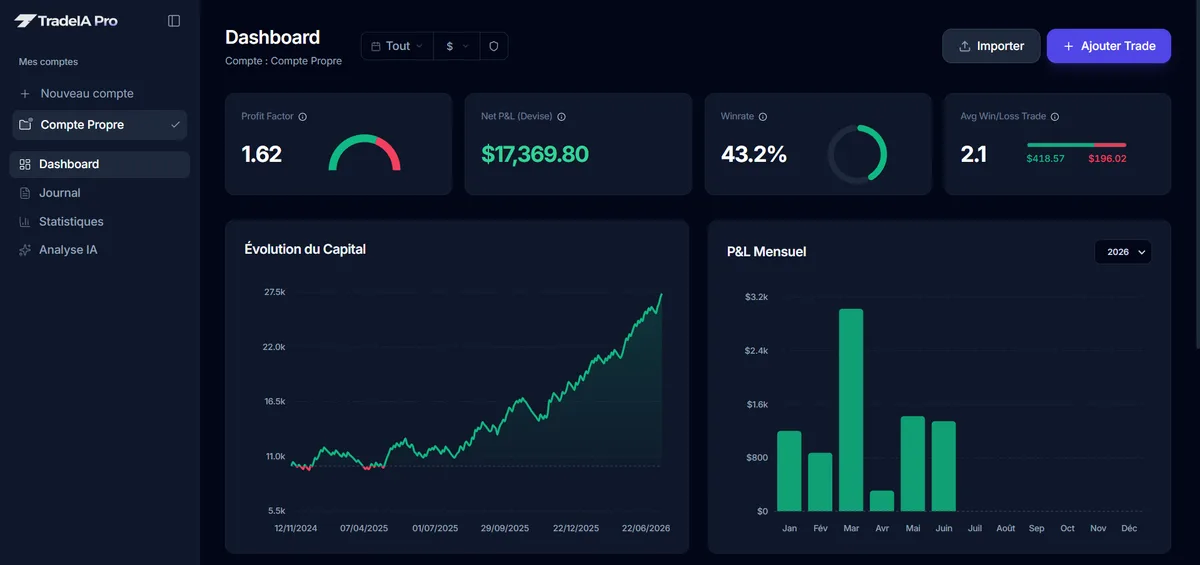
In TradeIA, you import your MT4, MT5, cTrader or TradingView history. The analysis flags, among other things, the time slots where you lose (at least 5 trades, win rate below 40% and a negative average result), the setups with a negative average result when you fill them in, and the days when your number of trades explodes compared to your average. That’s often where FOMO entries hide. TradeIA doesn’t guess your intention: it’s up to you to review those trades and recognize the ones that weren’t planned.
To put the stakes in perspective, the 2014 study by the AMF, France’s financial markets authority, covering 14,799 retail clients of Forex and CFD brokers, shows that 89% of them lost money between 2009 and 2013. FOMO doesn’t explain everything, but every entry at the wrong price brings your account closer to that statistic.
In short
FOMO in trading isn’t a lack of willpower, it’s a predictable reaction to whatever moves hard in front of you. Its cost is mechanical: a late entry, with the same stop and target, wrecks your ratio and demands an impossible win rate. Find your FOMO trades in your history with the six signals, put a number on what they cost you, then set a single rule this week: a limit order at the planned level, or nothing.
Frequently asked questions
05What is FOMO in trading?
FOMO stands for fear of missing out. In trading, it means opening a position because price is moving fast and you're afraid to miss the move, not because your plan gives a signal. The typical result is a late entry, close to a top or a bottom.
What is the difference between FOMO and revenge trading?
FOMO is triggered by a move you didn't take: you're afraid to miss a gain. Revenge trading is triggered by a loss you just took: you want your money back. Both lead to off-plan trades, but FOMO shows mostly as late entries, while revenge trading shows as trades opened right after a loss with a growing size.
How do I stop FOMO trading?
Decide your entries before the session and place limit orders at those levels. Set a simple invalidation rule: if price has already moved away from your planned entry by more than half the distance to your stop, you skip the trade. Then measure the result of your off-plan trades every month to see what they cost you.
Can FOMO be useful, for example to ride momentum?
Following a trend can be part of a strategy, as long as the entry, stop and target rules are written in advance and tested. What separates a momentum strategy from FOMO is not the direction of the trade but whether it was planned. A buy after a big rally decided in a rush is still FOMO, even if it ends up a winner.
What should I do when I miss a trade?
Let it go and log it in your journal as a missed trade, with the level where you should have entered. If the move comes back to test that level, your plan may give you another entry. Chasing price turns a missed trade, which costs nothing, into a bad trade, which costs money.
Sources
05- Przybylski A. K., Murayama K., DeHaan C. R. and Gladwell V., Motivational, emotional, and behavioral correlates of fear of missing out, Computers in Human Behavior (2013)
- Barber B. and Odean T., All That Glitters: The Effect of Attention and News on the Buying Behavior of Individual and Institutional Investors, The Review of Financial Studies (2008)
- Barber B., Huang X., Odean T. and Schwarz C., Attention-Induced Trading and Returns: Evidence from Robinhood Users, The Journal of Finance (2022)
- MetaQuotes, MetaTrader 4 Help, Account History
- AMF (France's financial markets authority), Study of retail investors' results trading CFDs and Forex in France (2014)
Educational content. It does not constitute investment advice. Trading leveraged products carries a high risk of losing your capital.