In short
Position size is calculated from risk, not from gut feeling: number of lots = amount at risk ÷ (stop distance × value of one point for 1 lot). With €10,000 and 1% risk, you risk €100: on EURUSD with a 25-pip stop and a pip worth €9.09 per lot, that gives 0.44 lot. Always round down.
Key takeaways
- Number of lots = amount at risk ÷ (stop loss distance × value of one point for 1 lot), all in your account currency.
- Position size follows from the stop, never the other way around: a wider stop requires a smaller position to keep the same risk.
- The value of a point depends on the asset and the account currency: check it in the symbol specification in MetaTrader.
- Leverage sets the maximum size allowed, not the sensible size: 0.44 lot on a €10,000 account is an effective leverage of only 4.4.
- Always round down and include commission: otherwise your real risk quietly exceeds your rule on every trade.
You know you should risk 1% per trade. But when you open the position, you put on 0.5 lot “because it feels reasonable”. The result: depending on how wide your stop is, your real risk swings between 0.3% and 3% from one trade to the next, without you knowing it.
This guide gives you the exact formula for position size calculation, four worked examples on the most traded markets, a ready-to-use table, and the mistakes that distort the calculation.
What is position size?
Position size is the volume you open on a trade, expressed in lots in MetaTrader. It is calculated from two choices you make beforehand: how much you accept to lose if the stop is hit, and where your stop is.
This calculation is what turns a risk rule (“1% per trade”) into a concrete decision. Without it, your rule only exists on paper.
The position size formula
Number of lots = amount at risk ÷ (stop distance × value of one point for 1 lot)
The three terms, in your account currency:
- Amount at risk = capital × risk percentage. With €10,000 and 1%, that is €100.
- Stop distance = the gap between your entry price and your stop loss, in pips or points.
- Value of one point for 1 lot = what you gain or lose when price moves one pip (or one point) with 1 lot. It depends on the asset and the account currency.
The product of the last two terms gives your loss for 1 lot if the stop is hit. Divide your risk by that loss and you get the size.
Position size follows from the stop, never the other way around. If your stop needs to be wider, your position needs to be smaller.
Example 1: EURUSD on a euro account
€10,000 account, 1% risk, 25-pip stop. With EURUSD at 1.10 (illustrative example):
| Step | Calculation | Result |
|---|---|---|
| Amount at risk | €10,000 × 1% | €100 |
| Value of one pip for 1 lot | $10 ÷ 1.10 | €9.09 |
| Loss for 1 lot at the stop | 25 pips × €9.09 | €227.27 |
| Position size | €100 ÷ €227.27 | 0.44 lot |
On EURUSD, 1 standard lot represents 100,000 euros and a pip is worth 10 dollars. Since your account is in euros, you convert those 10 dollars at the current rate.
Example 2: USDJPY, a yen pair
Same account, same risk, 40-pip stop. On yen pairs, a pip is 0.01. For 1 lot of 100,000 dollars, a pip is therefore worth 1,000 yen. With EURJPY at 160 (illustrative example):
| Step | Calculation | Result |
|---|---|---|
| Value of one pip for 1 lot | ¥1,000 ÷ 160 | €6.25 |
| Loss for 1 lot at the stop | 40 pips × €6.25 | €250 |
| Position size | €100 ÷ €250 | 0.40 lot |
Example 3: gold (XAUUSD)
At most brokers, 1 lot of gold represents 100 ounces: a 1-dollar move is worth 100 dollars per lot. Check it in the symbol specification, because some brokers use a different contract size. Stop of 8 dollars, EURUSD at 1.10 (illustrative example):
| Step | Calculation | Result |
|---|---|---|
| Value of a $1 move for 1 lot | $100 ÷ 1.10 | €90.91 |
| Loss for 1 lot at the stop | 8 × €90.91 | €727.27 |
| Theoretical size | €100 ÷ €727.27 | 0.1375 lot |
| Size rounded down | 0.13 lot |
With 0.13 lot, your real risk is €94.55. Rounding up to 0.14 lot would have taken it to €101.82, above your rule.
Example 4: an index (DAX, Nasdaq, S&P 500)
For indices, the value of one point per lot changes from broker to broker: it can be €1, €10 or €25 per point depending on the contract size. There is no universal value to memorize. If your broker shows €1 per point for 1 lot and your stop is 50 points away (illustrative example):
| Step | Calculation | Result |
|---|---|---|
| Loss for 1 lot at the stop | 50 points × €1 | €50 |
| Position size | €100 ÷ €50 | 2 lots |
The same calculation at a broker where 1 lot is worth €10 per point would give 0.2 lot. This is the main source of mistakes on indices.
Position size table by stop distance (EURUSD)
For €100 of risk on EURUSD, euro account, pip worth €9.09 per lot (EURUSD at 1.10):
| Stop loss | Loss for 1 lot | Position size |
|---|---|---|
| 10 pips | €90.91 | 1.10 lots |
| 15 pips | €136.36 | 0.73 lot |
| 20 pips | €181.82 | 0.55 lot |
| 25 pips | €227.27 | 0.44 lot |
| 30 pips | €272.73 | 0.36 lot |
| 50 pips | €454.55 | 0.22 lot |
| 100 pips | €909.09 | 0.11 lot |
For a different amount at risk, size scales proportionally: with €200 of risk, double the sizes; with €50, halve them.
Where to find the value of a point in MetaTrader
The official MetaTrader 5 documentation explains it: in the Market Watch window, right-click a symbol and choose Specification to see the conditions set by your broker. You will find:
| Specification field | What it tells you |
|---|---|
| Contract size | The number of units in 1 lot (100,000 on a currency pair, often 100 ounces on gold) |
| Tick size | The smallest possible price change |
| Tick value | What a one-tick change is worth for 1 lot |
| Minimal volume and volume step | The smallest size allowed and the increment, often 0.01 lot |
With tick value and tick size, you can work out the value of one point on any symbol without relying on an online calculator.
Leverage and position size: the confusion to avoid
Leverage does not set your risk. It sets the margin your broker ties up and the maximum size you can open.
Since 2018, ESMA, the European markets regulator, has capped leverage for retail clients on CFDs: 30 to 1 on major currency pairs, 20 to 1 on non-major pairs, gold and major indices, down to 2 to 1 on cryptocurrencies. With €10,000 and leverage of 30, you could open up to €300,000 of position, or 3 lots of EURUSD.
In example 1, the right size was 0.44 lot, or €44,000 of exposure: an effective leverage of 4.4. Maximum leverage is a limit, not a target. Treating it as a goal is one of the quickest routes to a deep drawdown.
The 5 mistakes that distort your calculation
- Choosing the size before the stop. You then place the stop where the loss “feels okay”, not where the market invalidates your idea.
- Forgetting the currency conversion. A pip worth 10 dollars is not a pip worth 10 euros. On a euro account, the gap is about 9% with EURUSD at 1.10.
- Rounding up. Systematic rounding up adds a few percent of risk to every trade.
- Ignoring commission and spread. If your broker charges $7 per lot round trip, add it to your loss per lot before dividing. On a tight stop, it changes the size.
- Increasing size after a loss. That is the mechanism of revenge trading: the calculation must start from your current capital and your rule, never from what you want to win back.
Checking your sizing discipline with TradeIA
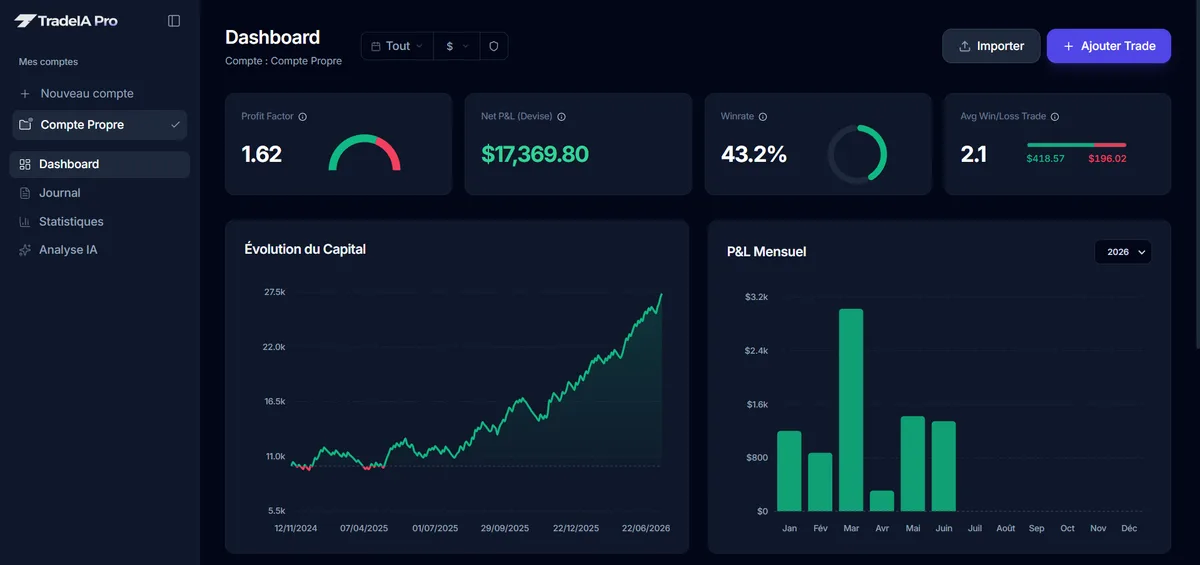
Calculating the right size is half the job. The other half is checking that you actually apply it. When you import your MT4, MT5, cTrader or TradingView history into TradeIA, the analysis compares the risk of your trades with each other and flags when it varies too much: when the standard deviation of your risk exceeds half of your average risk. It also spots losing streaks during which your size goes up.
That way you see whether your 1% rule exists in your history, or only in your head. To go further, record the size and the risk in R of every trade in your trading journal.
In short
Number of lots = amount at risk ÷ (stop distance × value of one point for 1 lot). Place the stop first, calculate the size next, and always round down. Check the value of a point in the symbol specification, include commission, and never confuse maximum leverage with sensible size. Do the calculation on every trade: it is what makes your risk rule real.
Frequently asked questions
05How do you calculate position size in trading?
First compute your amount at risk (capital × risk percentage), then the loss for 1 lot if your stop is hit (stop distance × value of one point per lot). Divide the first by the second. With €100 of risk and a €227 loss per lot, the size is 0.44 lot.
How much is a pip worth on EURUSD?
For 1 standard lot of 100,000 units, a pip is worth 10 US dollars. On a euro account you need to convert it: with EURUSD at 1.10, a pip is worth about €9.09 per lot. For 0.1 lot, it is ten times less.
What percentage of capital should you risk per trade?
There is no universal number. Many retail traders use between 0.5% and 2% per trade. The right level follows from the maximum drawdown you accept and the losing streak likely for your win rate.
Does leverage change position size?
No, it only changes the margin tied up and the maximum size your broker allows. Your risk depends on your position size and your stop. Leverage of 30 does not force you to open a position 30 times larger than your capital.
Where do you find the value of a point for an index or gold?
In MetaTrader, open the Market Watch window, right-click the symbol and choose Specification. You will find the contract size, tick size, tick value and volume step, which are specific to your broker.
Sources
03- MetaQuotes, MetaTrader 5 Help: Market Watch (symbol specification, contract size, tick value, volume step)
- ESMA, ESMA agrees to prohibit binary options and restrict CFDs to protect retail investors (2018)
- ESMA, Additional information on the agreed product intervention measures relating to contracts for differences and binary options (2018)
Educational content. It does not constitute investment advice. Trading leveraged products carries a high risk of losing your capital.